






 LIGHT
 2
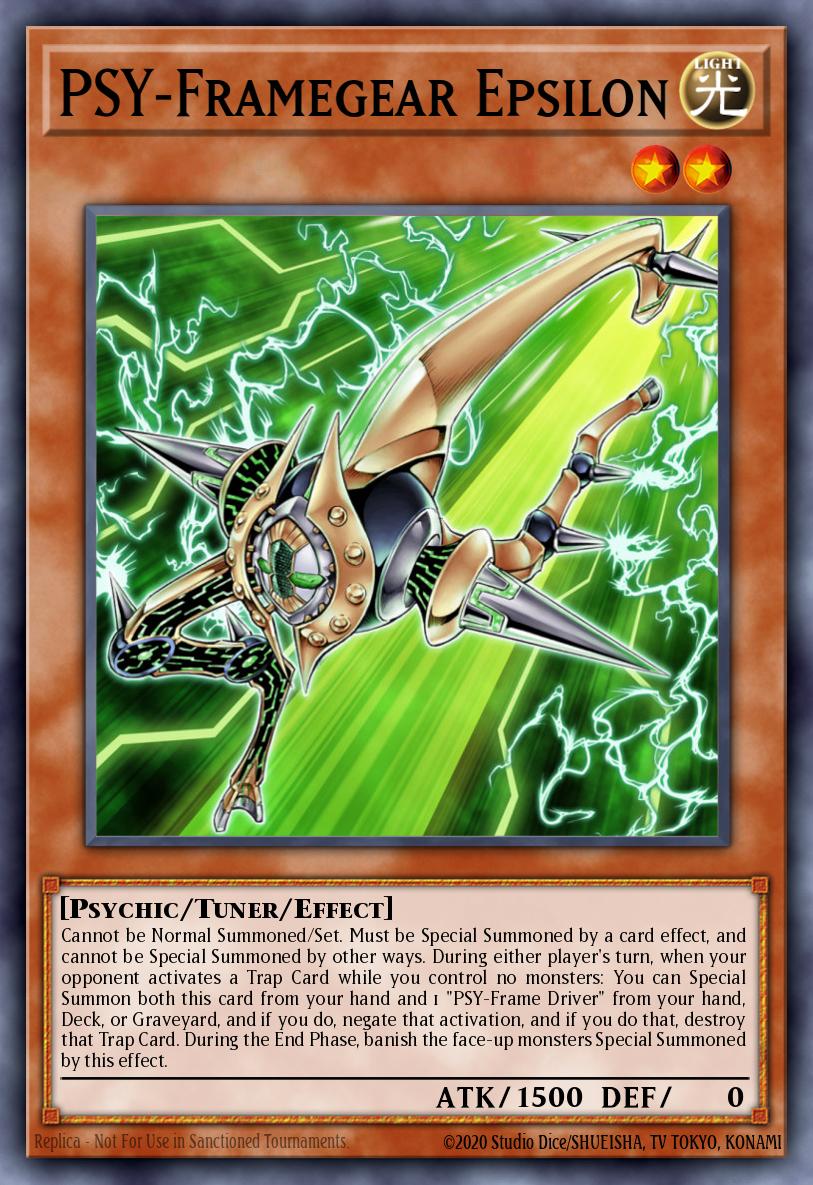
PSY-Framegear Epsilon
Archetype:
PSY-Frame
ATK:
1500
DEF:
0
View:
4086
Cannot be Normal Summoned/Set. Must be Special Summoned by a card effect, and cannot be Special Summoned by other ways. During either player's turn, when your opponent activates a Trap Card while you control no monsters: You can Special Summon both this card from your hand and 1 "PSY-Frame Driver" from your hand, Deck, or Graveyard, and if you do, negate that activation, and if you do that, destroy that Trap Card. During the End Phase, banish the face-up monsters Special Summoned by this effect.
PSY-Framegear Epsilon — Power Evaluation
Final Score: 71 ± 6 · Confidence: Medium
- Intrinsic: 70 · Deck: 69 · Meta: provisional
- Primary role: Removal / Negation · Secondary: Hand Trap, Material body
Why it scores here
PSY-Framegear Epsilon is a specialized control piece that negates and destroys opponent Trap activations while simultaneously generating two Synchro-enabling bodies. Its power derives from consistent access via PSY-Frame Driver (98.5% co-deck), high archetype portability (105 distinct homes), and hard interaction against Trap-heavy control strategies, not from combo depth or multi-turn recursion. The activation condition (opponent Trap, no board) and End Phase banish cost limit its flexibility, but these constraints are acceptable for a reactive negation tool rather than a combo engine.
Axis scores
| Axis | Score | Evidence |
|---|---|---|
| Accessibility | 75 | Appears in 100% of sampled decks with 1.87 copies average and is searchable via PSY-Frame Driver (98.5% co-deck), but activation requires opponent to run Traps while you control no monsters (verified) |
| Combo & Conversion | 45 | Summons itself plus PSY-Frame Driver as Tuner material, generating two bodies for one Trap negation, but neither body recurrs and both are banished at End Phase, limiting combo extension (inferred) |
| Resource Economy | 60 | Destroys one Trap Card and negates its activation, providing net +1 resource advantage through disruption, with no card draw or permanent field presence (verified) |
| Effect & Interaction | 70 | Hard negation of Trap activations plus destruction provides strong interaction quality, but coverage is limited to Traps only, excluding Spells and Monster effects (verified) |
| Material Utility | 75 | Tuner Monster with clean Level-2 and LIGHT-Psychic attributes that enables Synchro summons (observed via 53.2% Framelord Omega co-deck rate), though End Phase banish limits multi-turn value (verified) |
| Resilience & Flexibility | 60 | Searchable and runs efficiently at 2–3 copies with low garnet risk, but activation is narrow (opponent Trap + no board state), reducing flexibility across varied situations (verified) |
| Deck-Building Efficiency | 80 | Splashable across 105 archetypes with no self-locks or garnet risk, paired perfectly with PSY-Frame Driver (98.5% inclusion), and multiple copies remain efficient (observed) |
Calculation
Weight profile: 0.7 × Removal/Negation + 0.3 × Hand Trap. Intrinsic ≈ 70, Deck ≈ 69, Meta = provisional. Modifiers: Exceptional splashability (2). Final formula: 0.40 × Intrinsic (70) + 0.60 × Deck (69) + 2 modifier = 71
Strengths
- Guaranteed searchability via PSY-Frame Driver (98.5% co-deck), ensuring consistent access despite activation condition
- Hard negation plus destruction is clean, efficient interaction against Trap-based strategies
- Tuner type enables Synchro lines (Framelord Omega 53.2%, Delta 51.8%) while also functioning as negotiable material even when effect is negated
- Splashable across 105 archetypes with no self-locking, garnet risk, or deck-building penalty
- Efficient at 2–3 copies with low redundancy downside
Weaknesses
- Activation condition (opponent activates Trap while you control no monsters) is narrow and renders the card dead going first
- Covers Traps only; ineffective against Spell and Monster effect-based control strategies
- Combo conversion is minimal; summoned bodies are banished at End Phase with no recursion, limiting multi-turn value
- No hand advantage or card draw; purely tempo and disruption-focused
- Mandatory PSY-Frame Driver synergy creates deck-building dependency rather than standalone value
Counters / choke points
- Decks with minimal Trap activation (Spell or Monster effect-based control) reduce activation frequency
- Going-first strategies that establish board presence before opponent activation make the card dead
- Negation effects on Driver itself or Epsilon (e.g., Crossout Designator) disable the synergy
Best use
Reactive Trap negation and Synchro enabler. Decks: PSY-Frame (primary), Fiendsmith (4.2%), Primite (3.8%), Mitsurugi (3.5%), Performapal (3.2%), P.U.N.K. (2.8%), Sky Striker (2.8%), Synchron (2.5%).
Evidence & gaps
- Verified: 100% inclusion in 400-deck sample; 1.87 copies per deck average; Negates and destroys opponent Trap while summoning itself + PSY-Frame Driver; Both summoned monsters banished at End Phase (self-bouncing cost); Tuner Monster, Level 2, LIGHT Psychic; searchable via Driver (98.5% co-deck); Playable in 105 distinct archetypes; PSY-Frame Driver synergy mandatory (98.5% co-deck rate)
- Observed: 1.87 copies average, with distribution: 1 copy (40.5%), 2 copies (32.2%), 3 copies (27.2%); Strong synergy with PSY-Framelord Omega (53.2%) and Delta (51.8%), suggesting core Synchro role; Primarily in Control decks (79%), with minority in Combo (10.8%) and Aggro (10.2%); Multiple hand-trap staples co-occur: Ash Blossom (71.5%), Maxx C (56.8%), Called by Grave (67.2%)
- Inferred: Tuner type enables Synchro summons with Level-4 Drivers to produce Synchro-6 bodies (Framelord Omega, Baronne de Fleur common partners); Activation condition (opponent Trap, no board) gates the card to reactive play, making it dead going first; Effect-negated form still provides clean Tuner body for Synchro material, conferring residual value; Searchability via Driver compensates for the narrow activation condition
- Data gaps: No combos supplied — combo conversion is text-only inference; cannot verify multi-card sequences or board-state synergy No guides supplied — no human strategy context or advanced interaction patterns documented No banlist token — assumed 3-copy unlimited (no evidence of ban status in any format) No usage statistics (StatisticsCard) — archetype inclusion % and typical copies derived from 400-deck sample only, not broader historical data